(This is Suzy, Steve’s wife and caregiver.)
If you’re a friend reading our blog, this isn’t going to interest you much. This is more for the cancer patient who stumbles upon our blog in the future looking for some helpful info. It’s long and detailed because it’s what I was looking for when we started this, but couldn’t find anywhere.
A lot of this is specific to Steve’s treatment – chemo and radiation for head and neck cancer. He was diagnosed with HPV-related squamous cell cancer at the base of his tongue and in the lymph nodes in his neck. He had proton radiation (33 sessions) with adjutant chemotherapy of carboplatin and taxol (7 infusions).
Here’s a big caveat for those future patients, though – at our first appointment, we asked one of Steve’s doctors where to go for info, like books or websites. He simply said, “You ask me.” The internet is full of advice – some good, some bad. Early on, we decided to just follow the advice of our doctors and health care team. They’ve treated thousands of patients like Steve, and we trust them to know what they’re doing.
So I’m not trying to give advice, even though I sort of am. If you want to know if you need nutrition drinks or protein powder, your doctor is the person to ask, not me or the internet. I’m just giving you a list of random things we found helpful.
As the caregiver, there wasn’t always much I could do. Steve had to do all the hard stuff. But one thing I could do was plan ahead and prepare. I tried to think of everything Steve would possibly need. With the pandemic, I couldn’t just run into Target. Thankfully, some of the things ended up being unnecessary. And Steve thought some of the things were over the top… but that forehead thermometer really is a lot easier.
I love lists. My favorite coffee cup is Santa making his list and checking it twice. And I’m always wordy… so I’ll describe my lists, too. If you found this by chance because you or a loved one has just been diagnosed, I want to give you as much info as I can. I want to give you what I was looking for back in October.
LIST OF THINGS WE FOUND USEFUL:
- Ring Theory diagram and info (see below)
- Forehead thermometer
- Blood pressure machine
- Humidifier
- Super-soft towels
- Soft sheets and pillowcases (a couple of sets)
- Protective pillow covers (a couple of sets)
- Kleenex, lots of Kleenex
- Heated lap blanket
- Chair for the shower
- Fragrance-free shampoo
- Sensitive skin body soap (like Dove Sensitive Skin)
- Extra-soft toothbrushes
- Whiteboard and markers
- V-neck t-shirts, tank tops, or soft old t-shirts to cut the necks out of
LIST OF THINGS THAT WOULD HAVE BEEN USEFUL:
- A walker
- A simple list of what to do for symptoms, all in one place
- Asking people for help
Asking people for help – (Friends, if you’re reading this, don’t feel bad! You offered, and I said no.) Early on, lots of people offered to help. So break the ice and ask for help early on. Honestly, there wasn’t much that anyone else could do for us, especially with the pandemic. And Steve was doing incredibly well for such a long time – he was still making me coffee in the morning and unloading the dishwasher. We really didn’t need help. Then one day I realized I had eaten nothing but Greek yogurt and breakfast cereal, 3 meals a day, four days in row. We had stuff in the freezer, but it just took too much energy to make myself dinner. By then, it was right before Christmas and I knew everyone was busy and I felt that I’d be imposing if I asked friends to bring me food. And Steve only had a few more days of treatment anyway. So I got some Chinese food delivered and I obviously survived. But I didn’t follow the advice that others had given me – ask for help. I’m changing that to “Break the ice. Ask for help early on.” Then it’ll be easier to ask for help when you really need it.
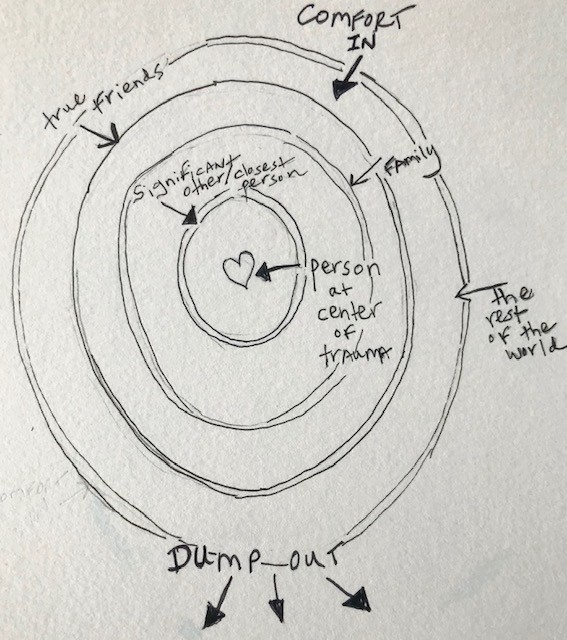
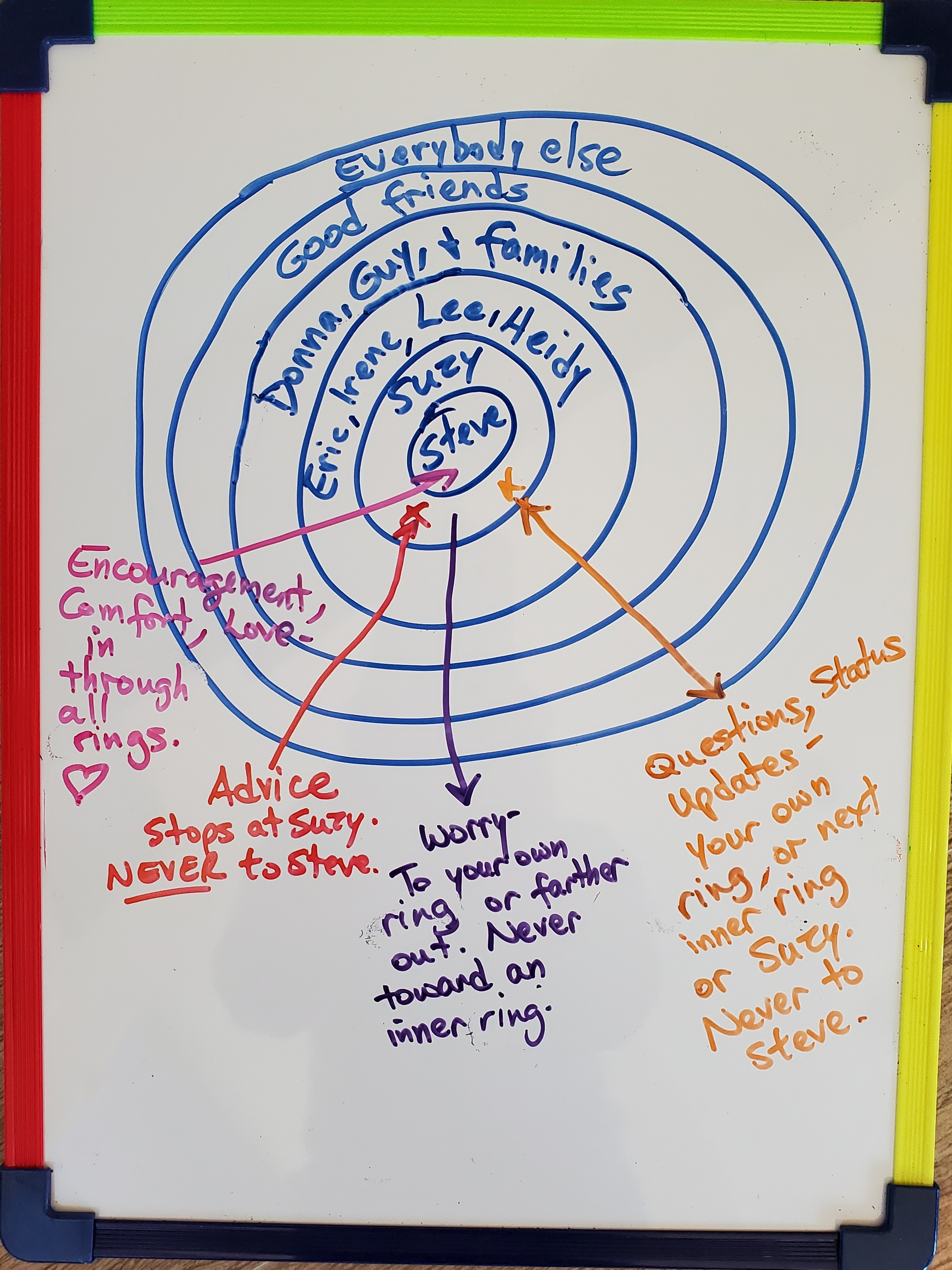
Ring Theory – This actually worked, and I thank everyone for letting me be Lord of the Rings. On the advice of a friend, I sent this to our family and friends soon after Steve was diagnosed. Basically, the patient is in the middle of some concentric rings, with the caregiver in the next ring, then family, friends, etc. in outer rings. Only love and comfort go in toward the middle rings. Bad stuff like worrying goes toward the outer rings. No advice goes directly to the patient, no asking the patient directly for updates. Let someone else filter those things, so the patient can concentrate on healing.
List of what to do for symptoms, all in one place – Believe it or not, after Steve’s first chemo, we completely forgot that Steve had nausea meds to use at home. He was feeling miserable and I was giving him ginger ale and crystalized ginger and toast — when right there on the counter sat not one, but two levels of nausea meds from the doctor. I really needed a post-it note that said “Nausea: ginger ale, crystalized ginger, med #1, med #2”. I thought of it as our tool kit – What’s in our tool kit for nausea? What’s in our tool kit for pain? What’s in our tool kit for low blood pressure? (Duh! I forgot to give him liquids when his blood pressure was too low — he was probably dehydrated.) I knew what to do, but just forgot. A few post-it notes would’ve helped.
Walker and shower chair – There were only a few days when I wished we had a walker. Twice when Steve fell because of low blood pressure, and a few other times when he just felt weak or dizzy. Same with the shower chair. Mostly the chair was just taking up space in the shower, but there were a few days when it was a necessity. Plus sitting in a nice warm shower felt good when I felt overwhelmed.
Super-soft towels and sheets – We did this early after hearing about how bad Steve’s skin might get from the radiation, so we had them when he needed them. The towels especially made a difference. The side benefit is now we have really soft towels and sheets. I tried a silk pillowcase, but it didn’t hold up to washing.
Kleenex – We read a book by a guy with tongue cancer who had so much phlegm and mucous he went through a box of Kleenex every day. When stores had pandemic supply chain problems, I stocked up on Kleenex. Then stocked up again. Sorry if you couldn’t find any in the stores… they’re in our closet. And yes, a box a day is a good estimate.
Whiteboard and markers – Many people undergoing radiation for tongue cancer have so much pain, it hurts too much to talk. That was one of the scariest side effects we had read about, which thankfully, didn’t happen to Steve. But just in case, I bought a 5-pack of little whiteboards, planning to leave them around the house for Steve to communicate with. They ended up being handy. We kept a whiteboard in the kitchen with our crazy appointment schedule every day. (And now seeing the empty whiteboard is even better!)
Shirts – I couldn’t find any specific advice on this anywhere, so we had to experiment. Steve’s neck was incredibly burned and painful from radiation, worse than we would ever have imagined. T-shirts, even v-necks, were unbearable. At home, he wore tank tops and soft t-shirts with the necks cut out. He wasn’t comfortable wearing cut-up t-shirts out in public to his appointments, so I found a couple of soft Henley button-up t-shirts. We thought a scrub shirt would work, but the neck wasn’t big enough and the fabric wasn’t soft enough.
Appointments – A helpful thing Steve did was record appointments on his phone – he asked each doctor, and none of them minded. While I waited in the car during Steve’s treatments (covid restrictions meant I couldn’t go in), I transcribed the recordings into notes in a big file on my PC. Just the act of listening to the recordings as I took notes was beneficial – I often heard something we hadn’t noticed during the appointment. And it was easy for us to search the file as compared to scribbled notes. How much Tylenol did he say? How long did she say to leave the Domeboro soak on?
Piles of Info – For a while, we forgot to actually look at the piles of stuff the doctors gave us. We had folders and booklets and handouts on chemo, radiation, nutrition, support groups, how to set up the portal. Our pile quickly became overwhelming, but there was actually good info there, once we looked at it.
Liquid Medications – Steve had trouble swallowing pills, so his doctor was able to prescribe some things as liquids. He said we could crush certain pills and take them with liquids or soft foods. Some things come in liquid form – Tylenol, Advil, and some vitamins for example (although some are kids’ versions). We didn’t think about this until a pill got stuck while Steve was trying to swallow it. Talk to your doctor.
Skin care – I hesitate to talk about this, because it’s giving advice that you should ask your doctor about. But Steve says it was a life-saver for him and wants me to include it, so here it is. The radiation burns on Steve’s neck were really, really, really bad. Doctors would see his neck and say “Wow, that looks painful”, they’d tell him that only time would make it better, then they’d tell him what he could use to alleviate the pain a bit. But the problem was that they didn’t tell him exactly how to do it. We couldn’t figure out how to get the xeroform gauze to stay on his neck. He struggled without asking for more help until one day he saw a nurse he didn’t usually see. She gave him a step-by-step plan. So yes, only time will make it better. But here’s what is helping Steve along the way. Talk to your doctor or nurse for details that would apply to you. And get the nurse to show you exactly how to get that dang gauze to stay around the neck! (And thank you, nurses, everywhere!)
Eucerin Skin Calming Lotion and Cream or something similar, Aquaphor Ointment, Lidocaine gel, Domeboro soaks, Xeroform gauze
Nutritionist – Steve’s doctor set him up with a nutritionist before his treatments even started, and she has been super helpful all along. She told us which nutritional drinks are complete meal replacements, and which should only be thought of as a snack. She gave advice on adding calories, protein, and flavor, and gave us the knowledge we needed to keep Steve’s weight up.
A way to keep track of insurance and bills — I used an Excel spreadsheet, but you’ll definitely need to figure out a method you can work with. Just know that you’ll have more explanations of benefits than you’ve ever seen in your life, in a very short time span.
Don’t rely on the internet – Sometimes the internet has good advice. Sometimes it has bad advice. It never has advice created specifically for you and your situation. We saw fellow patients complain about xyz, but not do what their doctor told them to do for xyz, instead doing something they saw online… then wonder why xyz wasn’t getting better. We ourselves got terrified by the internet – we saw survival rates for tongue cancer as low as 40%… but that wasn’t for Steve’s exact kind of cancer, or with Steve’s set of doctors and the technology they have. From the very beginning, we decided to trust Steve’s doctors and do what they said.
In telling us about treatments and potential side effects, every single one of Steve’s doctors told us “everyone is different”, and they’re right. He never experienced many of the side effects they told us about. The blogs and books we read were just another person’s experience. My lists just come from our own experience. Listen to your doctors and your health are team. They’ve done this a lot, and they know you and your specific situation.
Then you can make your own lists.

 Cancer in the time of corona
Suzy has said it all!
First, I want to reiterate to do what your doctor says. They do this everyday, all day long and talk to other doctors in constantly to see what’s working.
Second, if you need help ask your doctor, via the portal if you have one. They can point you the right direction.
Third, Suzy has been my saving grace. She sees things I don’t. If she tells me to do it, I listen. Every once in a while, she has to say it more than once. She can tell when I am tired, before I realize it. She can see when I haven’t been drinking or eating, etc., etc.
Lastly, take it a day at a time. It’s really hard, long, tough and sometimes brutal treatment and you’ll make it through it. Projecting yourself forward can make it tougher.
LikeLike
Lots of good info! Thank you for sharing!
Jennifer Blair
LikeLike
I hope its useful for you and that everything goes as smoothly as possible. Let me know if you ever need anything. I am just a call or text away.
LikeLike
Wow…this is spectacular…I will certainly be passing this along to anyone who asks me for advice about my tongue/lymph cancer. Right now, I need to go thank my Husband (again) because he was using the Ring Theory all along without even knowing it! Thank you for posting this publicly. I am finding so much truth and feel I can really relate to Steve – I can’t wait to read more – Miranda (from Mayo Head & Neck Support Group)
LikeLike
Thanks Miranda. It was night to meet you last night.
LikeLike
I keep reading these tips as this is coming up for my husband.
Now I wondered if I could get this what he has, I’ve had check ups and yearly exams, such a worry.
LikeLike
This is a great example of giving you guys. I imagine anyone unlucky enough to need this information will be very lucky indeed to have found you guys. Inspiration City around here! love you both, bobJuan.
LikeLike
Can’t thank you enough for this information. So kind of you. Best of luck to your family. Xoxo
LikeLike
Can you share the recipe for your high protien smoothie?
LikeLike
Peanut Butter Banana Smoothie – High Calorie, High Protein
½ cup whole milk OR a nutrition drink1 frozen banana¼ cup peanut butter½ cup whole fat yogurt¾ scoop protein powder2 packs Stevia or a tablespoon of honey2 tbs cream or half-and-half Salt (just a pinch)
he recipe as it’s written was good early in treatment, but it got too thick for Steve around week 4. You can add water or use more milk or nutrition drink to thin it out. Thinning it out makes more volume, but I ⁶Instead of milk, I often use a bottle of Core Power Elite, chocolate or vanilla (14 oz). That seems to make the perfect consistency for Steve, even though it ends up being 2 glasses of smoothie.
Sometimes I use Boost Very High Calorie, Vanilla (8 oz) instead of milk.
I add the cream or half-and-half at the end and stir it in by hand. I’m not sure, but it seems that blending it made the cream get too thick.
————-Mango Smoothie – high calorie
1 cup frozen mango1 cup whole milk or a nutrition drink¼ cup yogurt1 tbl honey or 1 pkg stevia1-2 tbs heavy cream or half-and-half1 scoop protein powder
I add the heavy cream at the end and stir it in by hand. It seems to get too thick if I blend it in the blender.
I often use Boost Very High Calorie Vanilla flavor instead of milk.
—————Mixed Berry Smoothie
1 ½ cups Naked Juice (Berry Blast)1 Frozen banana, sliced1 ½ cups Mixed frozen berries¾ cup Greek yogurt (5% fat)1 tbl Honey
Sometimes I have to add water to thin it out enough.
LikeLike